How to select the most suitable fire extinguishing device model for your electrical cabinet
“My electrical cabinet measures 800 × 600 × 300 mm. Should I choose a 20g or 30g aerosol fire extinguisher?”
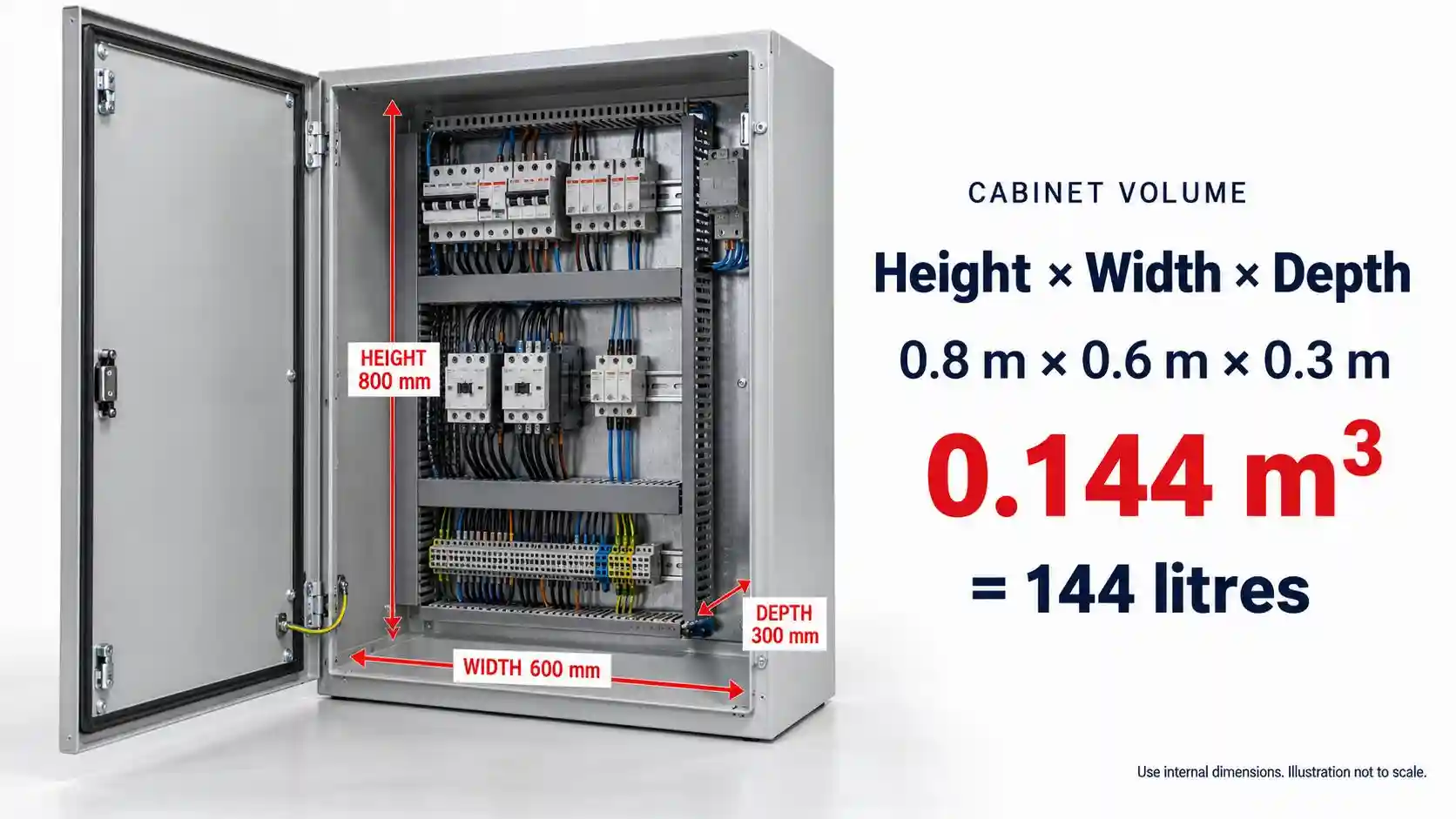
If those are the internal dimensions, the cabinet volume is 144 litres. Based on Ritchwave’s nominal protection volumes, a 20g device is the starting choice. The next step is to check ventilation, internal compartments and installation space.
That is the basic approach to aerosol fire extinguisher sizing: calculate the enclosure volume, match it to a model, then check the conditions inside the cabinet.
This guide compares Ritchwave’s 10g, 20g, 30g and 40g thermal aerosol fire extinguishing devices, with worked examples to help you prepare a selection enquiry.
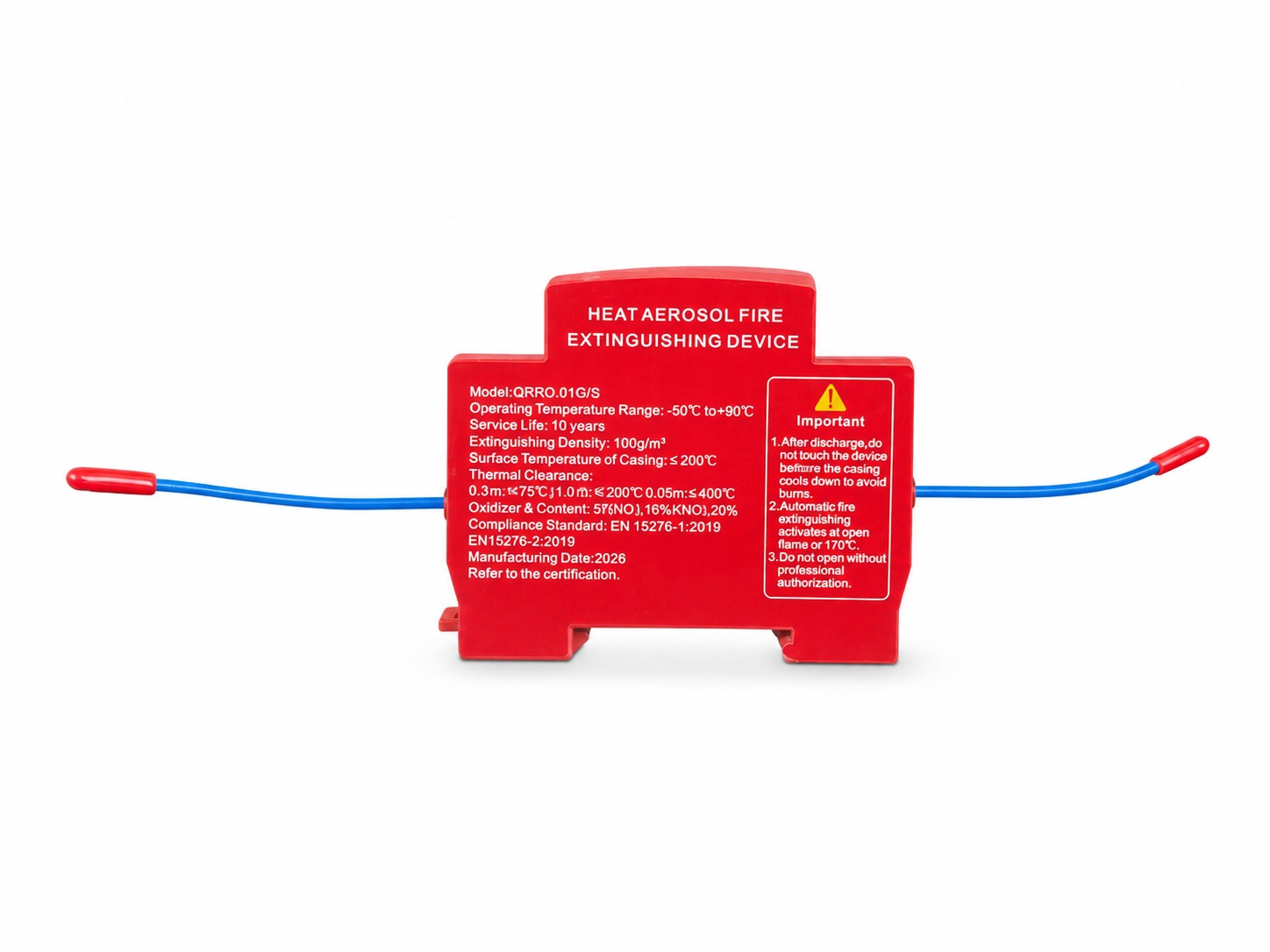
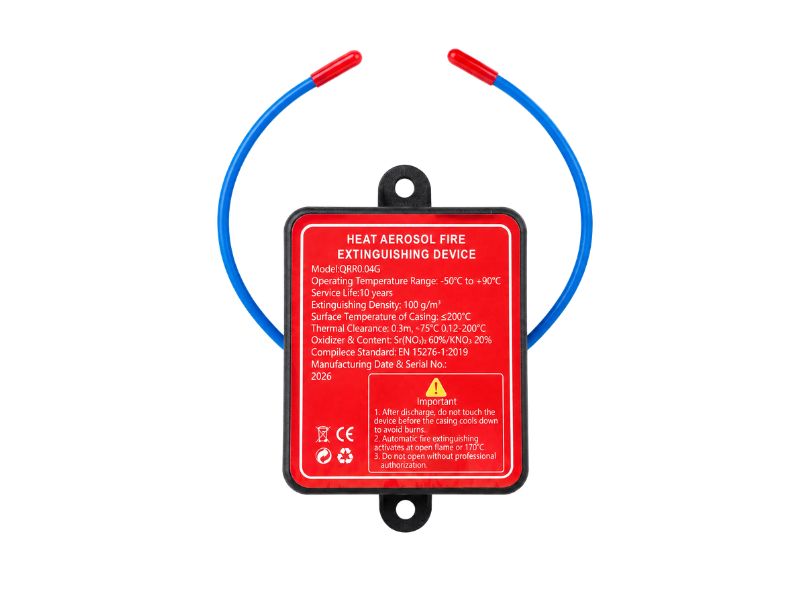
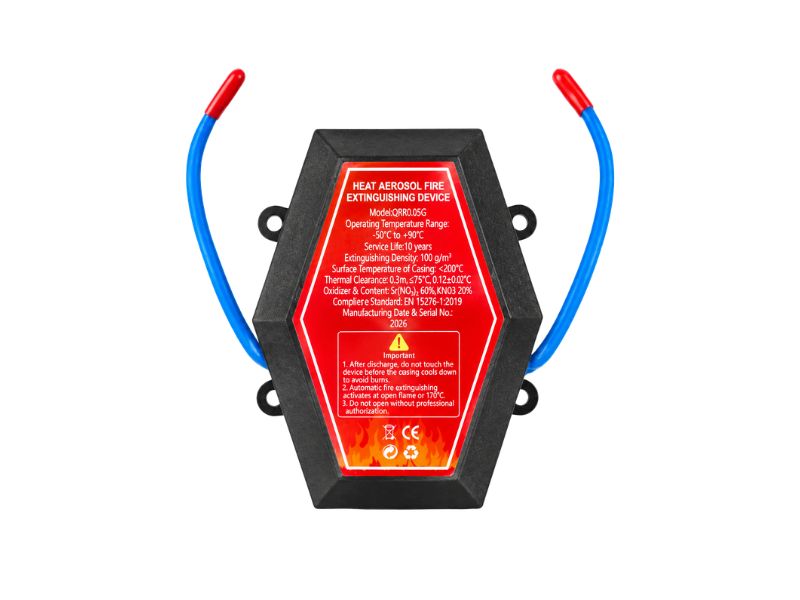
Aerosol Fire Extinguisher Size Chart: 10g to 40g
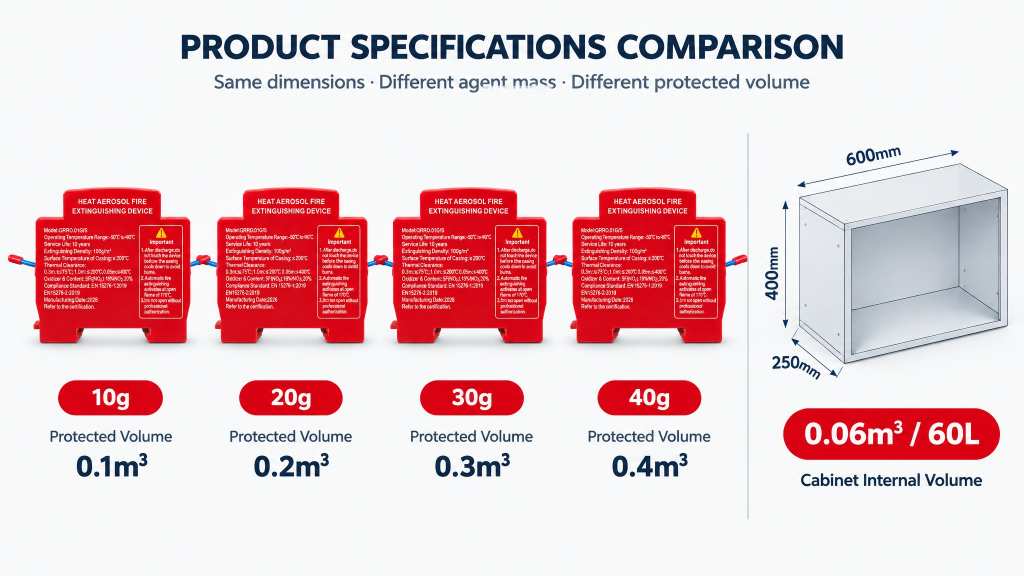
For suitable enclosed applications, Ritchwave specifies the following nominal protection volumes:
| Model | Nominal protection volume | Equivalent capacity |
|---|---|---|
| 10g aerosol fire extinguisher | 0.1 m³ | 100 litres |
| 20g aerosol fire extinguisher | 0.2 m³ | 200 litres |
| 30g aerosol fire extinguisher | 0.3 m³ | 300 litres |
| 40g aerosol fire extinguisher | 0.4 m³ | 400 litres |
These manufacturer-supplied ratings correspond to a nominal agent loading of 100 g/m³. They apply to enclosures that meet the product’s specified conditions; they are not universal ratings for every aerosol product.
Use volume, not floor area, when making the initial comparison. Two electrical cabinets can have the same height and width but very different depths. The deeper cabinet contains more space to protect.
How to Calculate Electrical Cabinet Volume
Measure the cabinet’s internal height, width and depth.
Internal volume = height × width × depth
Volume in m³ = height in m × width in m × depth in m
Volume in litres = height in mm × width in mm × depth in mm ÷ 1,000,000
For an electrical cabinet measuring 800 × 600 × 300 mm internally:
800 × 600 × 300 ÷ 1,000,000 = 144 litres
Or, in cubic metres: 0.8 × 0.6 × 0.3 = 0.144 m³.
The result exceeds the 10g model’s nominal 100-litre capacity and falls within the 20g model’s nominal 200-litre capacity. By volume alone, this points to the 20g model.
Use internal measurements where possible. If you only have external dimensions, identify them as external and verify the internal dimensions before final selection.
Do not automatically subtract the volume of breakers, contactors and cable ducts to justify a smaller unit. Follow the selected product’s sizing method for any permitted deductions.
Four Cabinet Sizing Examples
The examples below illustrate the initial volume match. Final selection requires suitable enclosure conditions and compliance with the product’s installation instructions.
| Internal dimensions: H × W × D | Calculated volume | Initial model match | Nominal protection |
|---|---|---|---|
| 600 × 400 × 300 mm | 0.072 m³ / 72 L | 10g | 100 L |
| 800 × 600 × 300 mm | 0.144 m³ / 144 L | 20g | 200 L |
| 1,000 × 600 × 400 mm | 0.24 m³ / 240 L | 30g | 300 L |
| 1,200 × 800 × 400 mm | 0.384 m³ / 384 L | 40g | 400 L |
When to Consider a 10g Aerosol Fire Extinguisher
A cabinet measuring 600 × 400 × 300 mm internally has a volume of 72 litres. This is within the 10g model’s nominal 100-litre protection volume.
Before confirming the model, check that the protected space is connected, the enclosure conditions are suitable, and the device can be installed with the required discharge clearances.
When to Consider a 20g Aerosol Fire Extinguisher
An 800 × 600 × 300 mm cabinet contains 144 litres. This exceeds the 10g model’s nominal capacity, so the initial match is 20g. Do not round the cabinet volume down simply because the smaller device looks sufficient or fits more conveniently.
When to Consider a 30g Aerosol Fire Extinguisher
When to Consider a 40g Aerosol Fire Extinguisher
A 1,200 × 800 × 400 mm cabinet contains 384 litres, close to the 40g model’s nominal 400-litre capacity. Verify the measurements and application conditions carefully. The remaining 16 litres should not be treated as an allowance that compensates for ventilation or leakage.
Three Checks Before Confirming Your Selection
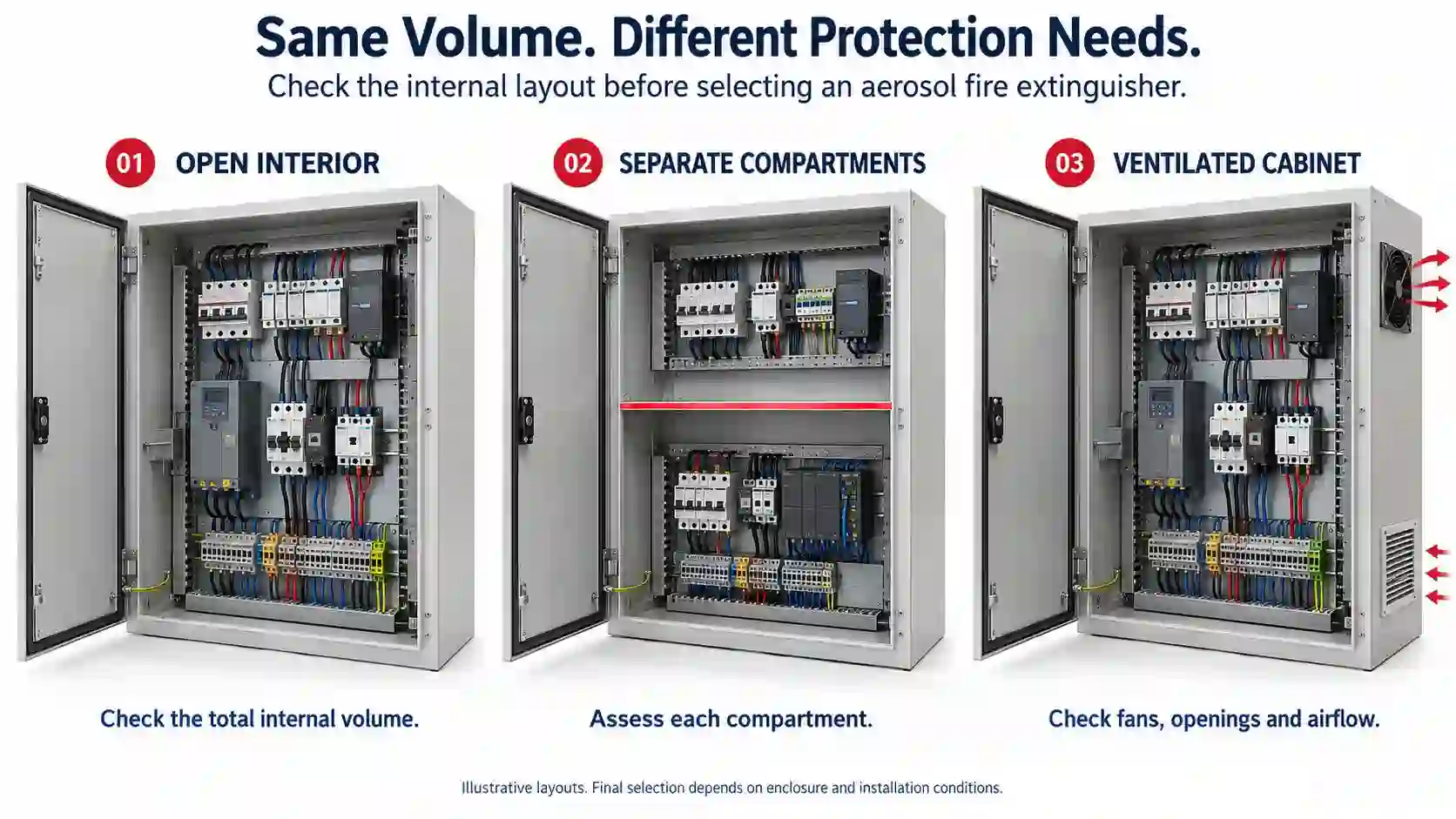
Electrical cabinet fire suppression requires more than a correct volume calculation. Before ordering, check how the cabinet is ventilated, how its interior is divided and where the device will fit.
1. Ventilation Fans and Openings
Record any cooling fans, extraction fans, ventilation grilles and unsealed cable entries. Air moving out of the enclosure can affect aerosol retention. A cabinet with continuous extraction needs further assessment; selecting the next size up is not an automatic solution.
Do not block ventilation that the electrical equipment needs for cooling. Send the fan and opening details to the supplier so that cooling requirements and fire protection can be considered together.
2. Internal Partitions
A single connected 240-litre cabinet is different from two separate 120-litre compartments. Aerosol released on one side of a solid partition cannot be assumed to protect the other side. Provide photographs showing partitions and any connecting openings, rather than relying on the cabinet’s overall dimensions alone.
3. Mounting Position and Discharge Clearance
For a DIN rail aerosol fire extinguisher, an empty rail position is useful only if it also meets the installation requirements. Check the discharge path, clearances and thermal sensing-element position. Cable ducts, wiring bundles and adjacent components must not obstruct the device’s operation.
Is a Larger Aerosol Fire Extinguisher Always Better?
Can Two 10g Units Replace One 20g Unit?
This is generally feasible, as two 10g units contain the same nominal total mass of agent as a single 20g unit.
However, when using multiple units, factors such as placement, activation, and aerosol distribution must be taken into account.
The same applies to enclosures with a volume greater than 0.4 cubic meters.
Activation Temperature, Service Life and Moisture Protection
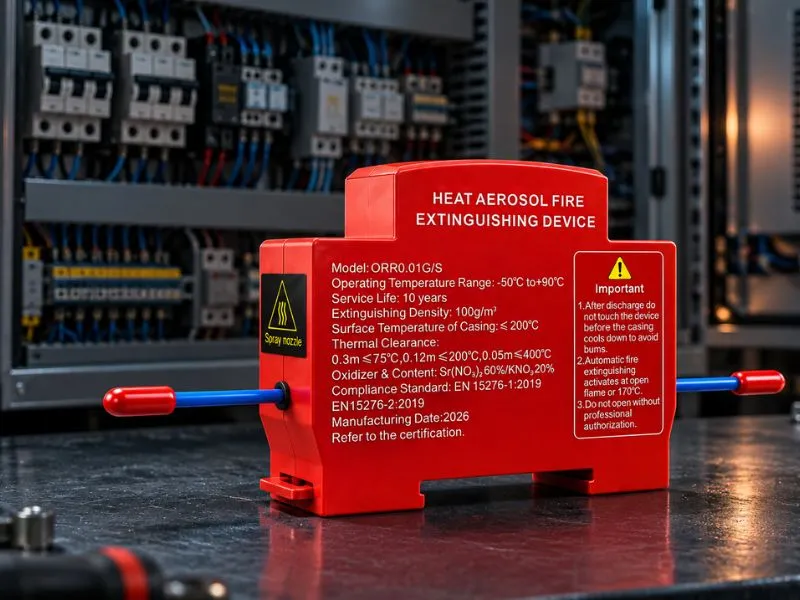
Ritchwave specifies an activation temperature of approximately 170°C and a service life of 10 years for these four models, subject to the required storage and operating conditions.
The activation temperature relates to the thermal sensing element. It does not mean the whole cabinet must reach 170°C, and it is not a continuous operating-temperature rating.
Moisture conditions should also be checked before selection. An indoor electrical cabinet can still develop condensation. Look for droplets, water marks and damp cable-entry areas, and address persistent moisture before installation.
Store unused devices in dry conditions and inspect installed units according to the product instructions.
Frequently Asked Questions About Aerosol Fire Extinguisher Sizing
What size aerosol fire extinguisher do I need for a 0.15 m³ cabinet?
For Ritchwave’s range, 0.15 m³ falls within the 20g model’s nominal 0.2 m³ protection volume. This is the initial volume match; ventilation, compartments and installation conditions still need checking.
Can I use a 10g device for a cabinet slightly larger than 0.1 m³?
A cabinet larger than 0.1 m³ exceeds this model’s stated nominal protection volume. Do not round down. Check the next suitable model and confirm the application conditions.
What if the cabinet volume is exactly at the model’s rated limit?
Verify the dimensions and all conditions attached to the rating. Do not assume there is an additional margin for openings, airflow or other factors beyond the stated rating.
Do I need to measure the inside or outside of the cabinet?
Use internal dimensions for the initial volume calculation. If only external dimensions are available, mark them clearly and verify the internal measurements before final selection.
Does a 10-year service life mean a 10-year warranty?
No. Service life describes the specified usable period under the required conditions. Warranty coverage is a separate commercial term that should be confirmed in the quotation.
Thermal Aerosol Fire Extinguishing Device
Questions about your application?
Explore our fire safety products, or contact our team to discuss product specifications and your requirements.
Contact our team